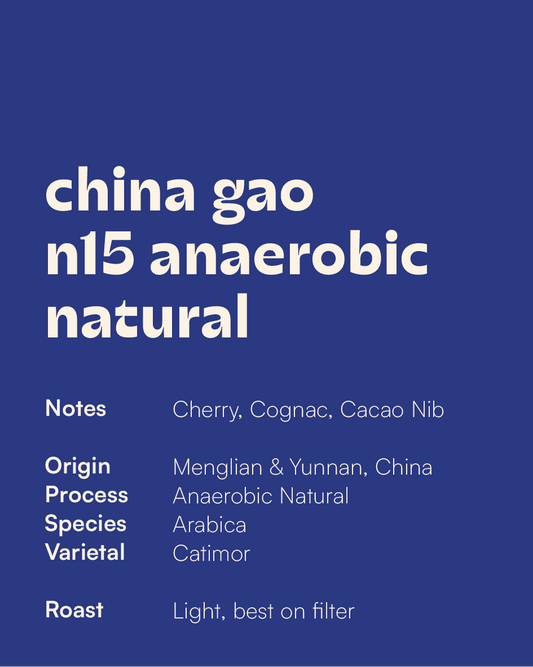
The Gao family is the pioneer of growing coffee in China, their family planted one the the earliest coffee tree in Yunnan in the 1950’s. For years, they have been producing an enormous volume of coffee for massive global brands. Until 2018, the year that I had my first ever specialty graded Chinese coffee, they won the Menglian Specialty Coffee Gold Award. Since then, they started getting more serious about growing specialty coffee in Yunnan. Gao is the earliest coffee farm to adopt modern and digital agricultural methods, including soil testing, organic and targeted fertilization, drone-based pest control, and biological varietal management.
Gao’s Anaerobic Natural N15 is the first funkier coffee I had from China. The cup experience alone has been mindblowing because of how expressive it is on the palate. The details in the fermentation phase and process of this coffee explain it all: to make this coffee more fruit forward, the producer sealed the whole fruit inside oxygen-deprived tanks for a hyper-controlled fermentation phase. This environment forces intense fruit sugars and complex acids deep into the core of the seed, and the coffee is then slowly and carefully sun-dried on raised beds. Paired with the Catimor variety, the whole structure of the coffee becomes a sweet, all-rounded, fruity, and expressive cup that reminds me of black forest cake.
250g bag. Roasted in Toronto, Ontario.
Orders placed by Sunday @ 11:59pm EST will be roasted Monday to Wednesday and shipped as soon as possible. Orders process and ship out within 2-5 business days.
China’s coffee story is relatively young but growing rapidly. Coffee cultivation began in the late 19th century when French missionaries introduced Arabica plants to Yunnan Province. For decades, production was small-scale and primarily focused on local consumption, with tea remaining the dominant drink of choice. However, things began to change in the late 20th century as demand for coffee grew both domestically and internationally. Today, Yunnan is at the heart of China’s coffee industry, producing more than 95% of the country’s beans. Producers here are experimenting with innovative processing methods and focusing on specialty-grade Arabica. The result? Coffees with unique flavour profiles, often featuring bright acidity, floral notes, and sweetness. China’s specialty coffee scene is still finding its footing on the global stage, but with its rapid growth and increasing quality, it’s clear: China is no longer just a tea country.
What's exciting about this coffee
The Bisal Munti really stood out in terms of profile and good processing. After the cupping, it blew my mind to find that this coffee was grown at a pretty low altitude at 650 meters! On the table it had a lot of candied plum, chocolate, and salted caramel.